

Measuring quality in construction is difficult because a construction project is not a controlled manufacturing line.
The work changes from one location and trade to another, different subcontractors are involved, many activities are covered up by later work, and every project has its own drawings, specifications and contractual requirements.
But construction quality can still be assessed and monitored properly. The practical approach is to compare the work against clearly defined acceptance criteria, inspect it at the right stages, record the results and then monitor trends in defects, tests, approvals, handover records and client feedback.
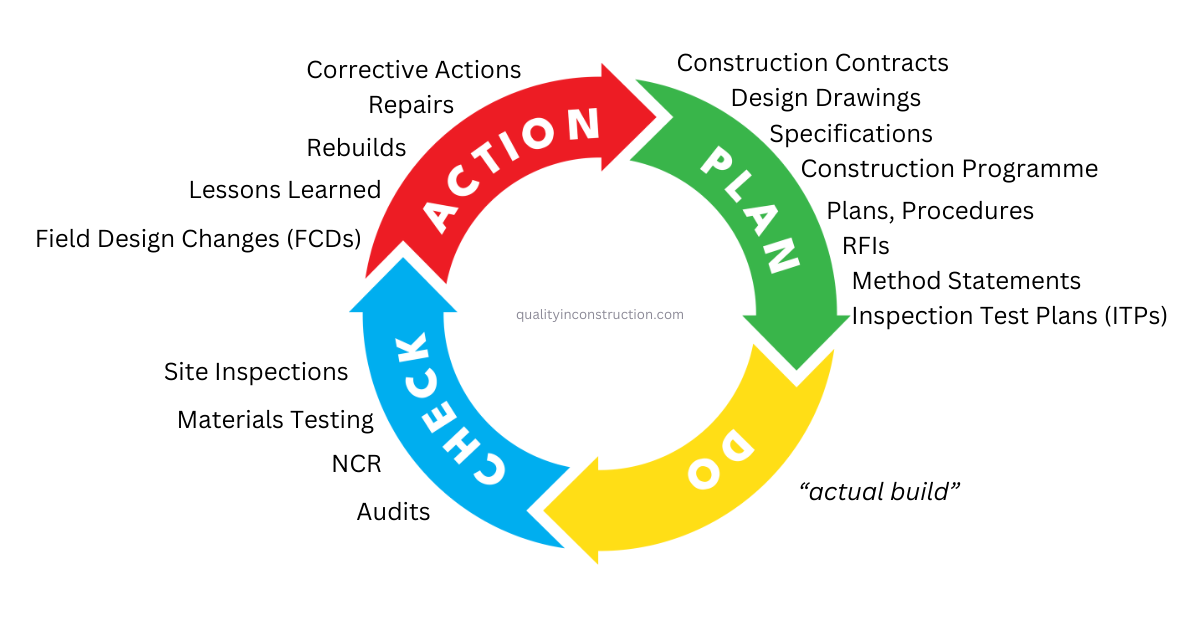
In simple terms, to assess the quality of construction work you should:
- Define what acceptable work looks like using the drawings, specifications, standards and approved method statements.
- Plan inspections and tests before the work starts.
- Check materials, workmanship and completed work against measurable acceptance criteria.
- Record conforming and nonconforming results.
- Monitor quality indicators and recurring problems throughout the project.
- Use the findings to correct the work and improve the process.
This guide explains how to assess the quality of construction work, how to monitor construction site quality and which practical quality indicators can help you understand whether the project is genuinely under control.
What Does Construction Quality Mean?
Construction quality means that the materials, workmanship, completed works and project processes conform to the agreed requirements.
Those requirements normally come from the contract, approved drawings, technical specifications, applicable codes and standards, approved material submittals, method statements and inspection and test plans.
Quality is therefore not simply whether the finished work looks good.
A concealed waterproofing layer, concrete foundation or pressure-tested pipe may look perfectly acceptable but still fail a specified requirement. Proper construction quality assessment needs objective evidence.
That evidence may include:
- Inspection requests and completed checklists
- Material certificates and approval records
- Laboratory and site-test results
- Survey and dimensional-control records
- Photographs and traceability records
- Nonconformance reports and corrective actions
- Audit reports
- As-built drawings and handover documentation
How to Assess the Quality of Construction Work
The quality of construction work should be assessed while the work is being planned and executed, not only after it has been completed.
Waiting until the end creates disputes, expensive rework and problems with work that has already been covered up.
1. Establish the applicable requirements
Before assessing any activity, identify the requirement against which it will be checked. Saying that workmanship is “poor” is not enough.
The inspector should be able to point to an approved drawing, specification clause, tolerance, standard, manufacturer’s instruction or approved sample.
The project team should also confirm that it is using the latest approved information. Inspecting work against an obsolete drawing is not effective quality control, even if the inspection itself is thorough.
2. Convert the requirements into acceptance criteria
Acceptance criteria translate technical requirements into checks that can be applied on site.
They may cover dimensions, levels, material grades, test values, surface finish, installation sequence, curing conditions, torque values, pressure limits or permitted tolerances.
Where possible, the criteria should be measurable. “Installed correctly” is vague; a stated tolerance, approved detail or test result is much easier to inspect consistently.
3. Plan the inspections and tests
The relevant Inspection and Test Plan should define what will be inspected, when it will be inspected, who is responsible, the applicable acceptance criteria, the records to be produced and any hold or witness points.
Inspections should be scheduled before the work is covered, made inaccessible or allowed to proceed beyond a critical stage.
This is especially important for reinforcement, underground services, waterproofing, concealed services and work subject to mandatory hold points.
4. Inspect materials and workmanship
Material inspections should verify that the delivered product matches the approved submittal and that certificates, identification, storage conditions, shelf life and traceability are acceptable.
Workmanship inspections should then confirm that the material has been installed in accordance with the approved information and acceptance criteria.
The result should be recorded as accepted, rejected or accepted subject to a clearly documented action.
5. Record and act on the findings
An inspection that produces no reliable record has limited value.
The record should identify what was inspected, where and when the inspection took place, the criteria used, the result, the people involved and any supporting evidence.
When the work does not conform, the team should control the affected work and use the agreed NCR process.
Significant or recurring issues may also require root-cause investigation and corrective action.
6. Verify completion and close-out
Corrected work should be reinspected, and outstanding actions should not disappear simply because the next activity has started.
Closure must be supported by evidence that the correction was completed and the work now meets the applicable requirement.
How to Monitor Construction Site Quality
Assessing individual activities tells you whether particular work conforms.
Monitoring construction site quality tells you whether the project’s quality controls are working over time.
A practical monitoring system should bring together information from inspections, tests, NCRs, audits, RFIs, documents, handover records and client feedback.
Looking at one indicator in isolation can produce a distorted picture.
For example, a project with no NCRs is not automatically a high-quality project.
It may indicate that problems are not being identified or reported. In the same way, a large number of inspections means very little if they are late, incomplete or performed without meaningful acceptance criteria.
Use both leading and lagging quality indicators
Leading indicators show whether preventive controls are being implemented before failures occur. Examples include planned inspections completed on time, approved ITPs in place, quality briefings delivered and material approvals obtained before use.
Lagging indicators show what has already gone wrong. Examples include rejected inspections, failed tests, NCRs, rework, defects and client complaints.
A useful construction quality dashboard needs both. Leading indicators show whether the system is being applied; lagging indicators show the outcomes it is producing.
Construction Quality KPIs and What They Tell You
| Quality indicator | What it measures | Example calculation |
|---|---|---|
| Inspection pass rate | Conformity of inspected work | Accepted inspections ÷ completed inspections × 100 |
| First-time pass rate | Work accepted without correction or reinspection | First-time acceptances ÷ completed inspections × 100 |
| Test failure rate | Frequency of nonconforming test results | Failed tests ÷ total tests × 100 |
| NCR closure time | Speed at which nonconformities are resolved | Total days to closure ÷ NCRs closed |
| Overdue NCR rate | Control of unresolved quality issues | Overdue open NCRs ÷ total open NCRs × 100 |
| Repeat NCR rate | Effectiveness of corrective action | Repeated NCRs ÷ total NCRs × 100 |
| Rework cost | Financial impact of quality failures | Cost of rework as a percentage of project value |
| RFI response time | Timeliness of technical clarification | Total response days ÷ RFIs answered |
| Audit-action closure | Follow-up of audit findings | Actions closed on time ÷ actions due × 100 |
| Handover readiness | Completion of required quality records | Accepted records ÷ required records × 100 |
The correct targets will depend on the contract, activity and project maturity. Avoid choosing a target simply because it looks impressive. The metric should help the team identify risk, make a decision or improve a process.
Six Practical Ways to Measure Quality in Construction Projects
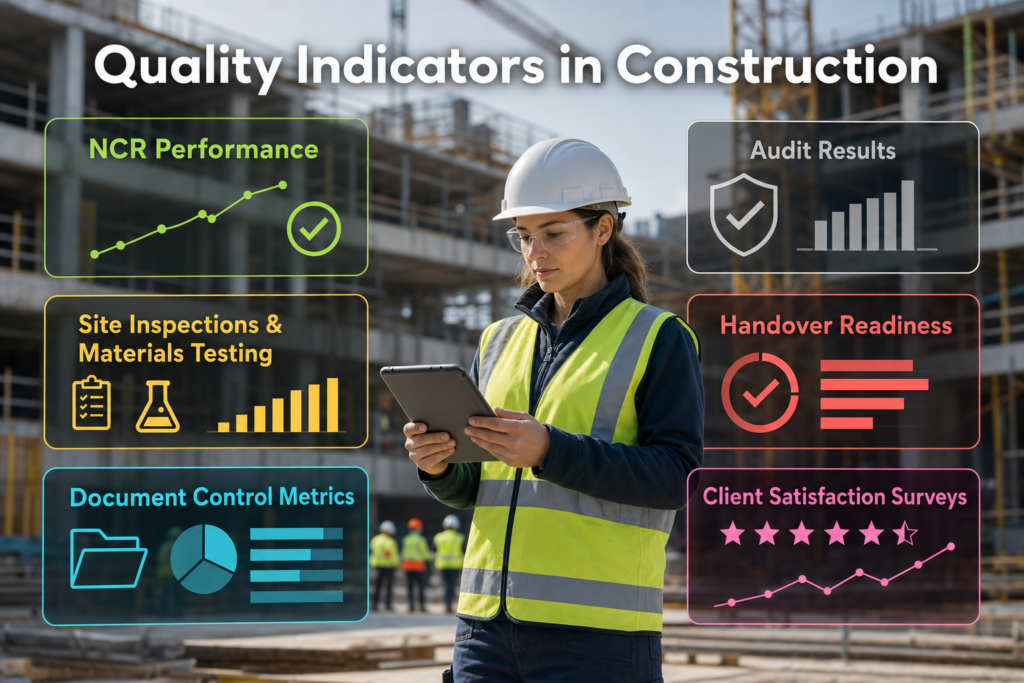
Speaking from my experience in construction, the following areas provide a realistic picture of project quality without turning the system into a bureaucracy.
1. NCRs in Construction
Measuring and monitoring nonconformities is one of the most useful quality-control tools in an environment as variable as a construction site. Every serious construction project should have a clear process for identifying, reporting, controlling and closing work that does not meet the requirements.
To obtain reliable information from NCRs, the project needs:
- A practical NCR procedure supported by project management
- A consistent NCR form or software workflow
- An NCR register showing status, responsibility, due dates and trends
- Agreed classifications for disciplines, causes and severity
- Evidence-based closure and, where required, corrective action
Useful measures include the number of open and overdue NCRs, average closure time, repeat nonconformities, NCRs by subcontractor or activity and the percentage requiring corrective action. See also how to close an NCR in construction.
However, NCR numbers must be interpreted carefully. A project with thousands of NCRs may have serious problems, but a project with none may simply have a culture in which problems are hidden. NCRs show what has been reported; they do not automatically reveal everything that has gone wrong.
2. Site Inspections and Materials Testing
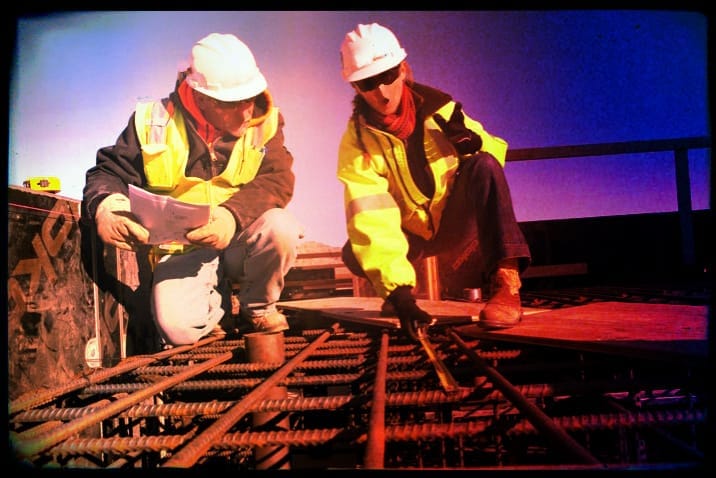
Materials testing and work inspections are integral to construction quality control. They should follow an agreed regime defined in the relevant Inspection and Test Plan.
Concrete testing is an obvious example, but construction projects may also include compaction testing, welding inspection, coating tests, pressure testing, electrical testing, surveys, waterproofing tests and commissioning activities.
Every inspection or test provides evidence of conformity or nonconformity.
Monitor more than the total number completed.
Look at first-time pass rates, rejected inspection requests, failed test trends, late inspections, missed hold points, incomplete records and repeated problems by activity or subcontractor.
3. Document Control and RFI Data
The flow of drawings, submittals, RFIs and technical information is critical to modern construction management.
Late approvals, uncontrolled revisions and unanswered technical questions can cause delays, rework and contractual disputes.
Useful document-control measures include:
- Documents submitted by the planned date
- Average review and approval time
- Number of resubmissions required before approval
- Overdue submittals and technical queries
- Distribution of current construction documents
- Withdrawal of superseded drawings from points of use
- Response time for RFIs in construction
- Evidence that RFI responses were incorporated into the work
These are not merely administrative statistics. A team building from the wrong revision is a direct construction quality risk.
4. Internal and External Audit Data
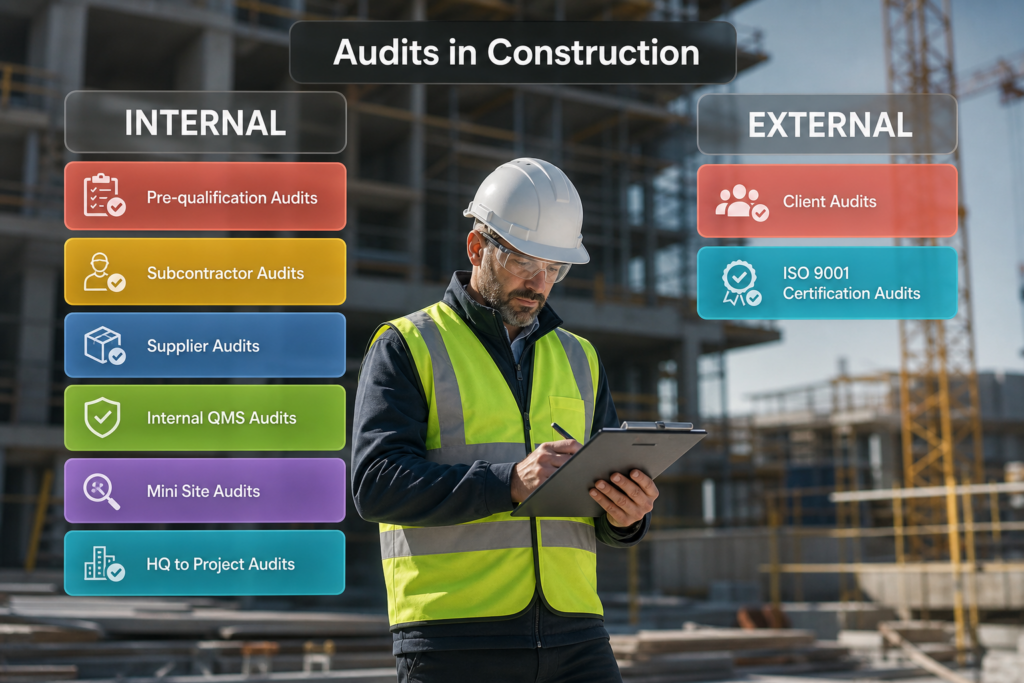
A construction quality audit evaluates whether the planned processes are being followed and whether those processes are effective.
Audits can examine the project team, a subcontractor, a supplier, a specific activity or a particular management process.
Monitor audit findings by process, severity, cause, responsible party and closure status. Repeated findings and overdue actions are especially important because they may indicate that the project is correcting individual symptoms without improving the underlying system.
5. Handover Readiness and Completion
A common construction problem is leaving handover documentation until the end.
When it is finally requested, teams scramble to find test reports, signed check sheets, certificates, commissioning records and as-built drawings.
Handover readiness should be monitored throughout the project.
A simple tracker can compare the records required for each system, area or work package with those produced, reviewed and accepted.
Useful indicators include the percentage of required records accepted, overdue as-built drawings, incomplete test packs, outstanding defects and systems ready for handover.
Monitoring these indicators early reduces the risk of practical completion being delayed by missing evidence.
6. Client Satisfaction and Feedback
In construction, one of the most direct ways to understand client satisfaction is to ask.
A short survey or structured review can capture feedback on workmanship, responsiveness, communication, documentation, safety coordination, programme performance and the handling of defects.
Individual answers can be subjective, so do not rely on a single score.
Look for changes over time and recurring comments.
Combine formal surveys with complaints, meeting actions, repeat business, approval delays and close-out feedback.
How Often Should Construction Quality Be Monitored?
The frequency should match the risk and pace of the project:
- Daily: critical inspections, failed tests, rejected work, hold points and urgent NCR containment.
- Weekly: inspection status, upcoming ITP activities, overdue NCRs, testing, material approvals and RFI constraints.
- Monthly: KPI trends, subcontractor performance, audit findings, rework, handover readiness and client feedback.
- At project milestones: readiness reviews before major pours, energisation, commissioning, completion and handover.
Reporting more frequently does not automatically improve control. The review should lead to decisions, named actions, responsibilities and deadlines.
Construction Quality Assessment Checklist
Use this short checklist when reviewing how quality is being managed on a construction project:
- Are current drawings, specifications and approved submittals available at the point of use?
- Are acceptance criteria clear and measurable?
- Are ITPs approved before the relevant work starts?
- Are materials verified before installation?
- Are inspections completed before work is covered?
- Are hold and witness points respected?
- Are inspection and test records complete and traceable?
- Are failed tests and nonconforming work controlled immediately?
- Are NCRs investigated, corrected and closed with evidence?
- Are recurring problems analysed rather than repeatedly repaired?
- Are subcontractor and supplier quality trends reviewed?
- Are quality records collected progressively for handover?
- Are quality KPIs reviewed with the project management team?
- Do reviews result in clear actions and follow-up?
Common Mistakes When Measuring Construction Quality
- Counting activity instead of effectiveness: the number of inspections completed does not show whether they were timely or useful.
- Using NCR numbers as the only quality measure: low reporting may reflect a weak quality culture rather than good work.
- Choosing too many KPIs: a massive dashboard that nobody uses creates administration and beraucracy, not improvement.
- Ignoring leading indicators: measuring failures without monitoring preventive controls means acting too late.
- Comparing unlike projects: project size, stage, complexity and reporting culture must be considered.
- Collecting data without action: quality metrics have no value if trends are not reviewed and addressed.
- Rewarding artificially low numbers: teams may stop reporting issues when the metric is used to blame them.
Frequently Asked Questions
How do you assess the quality of construction work?
Assess construction work by comparing the materials and workmanship with approved drawings, specifications, standards, method statements and measurable acceptance criteria. Inspect the work at planned stages, complete the required tests, retain objective records and control any nonconforming results.
How do you monitor construction site quality?
Monitor site quality by reviewing inspection pass rates, test results, NCR trends, rework, document approvals, RFIs, audit findings, handover readiness and client feedback. Use both leading indicators, which show whether preventive controls are in place, and lagging indicators, which show failures that have already occurred.
What is the best KPI for construction quality?
There is no single best KPI. First-time inspection pass rate, repeat NCR rate, test failure rate, rework cost and handover readiness provide different information. A small balanced group of indicators is more useful than relying on one number.
Who is responsible for construction quality?
The contractor is normally responsible for controlling its work, but quality is not the responsibility of the quality department alone. Project managers, engineers, supervisors, subcontractors, suppliers and workers all have responsibilities. Consultants and clients may verify or accept the work, but their inspection does not replace the contractor’s own quality control.
Is an inspection the same as a quality audit?
No. An inspection checks a product, material or activity against defined acceptance criteria. An audit evaluates whether a process or management system is planned, implemented and effective. Both provide important but different evidence.
Final Thoughts
Measuring quality in a construction project requires planning, reliable records and an honest reporting culture. NCRs, inspections, test results, document-control data, audit findings, handover records and client feedback all provide useful information, but no single measure gives the complete picture.
The objective is not to create the largest possible dashboard. It is to identify whether the work conforms, whether the project’s controls are effective and where action is needed before quality problems become delay, rework, cost or disputes.
When the requirements are clear, inspections happen at the correct time and trends are discussed openly, construction quality becomes much easier to assess, monitor and improve.
Very impressive and helpful.